
A golf scramble is a best ball golf format where every player on a team hits a drive. After all players hit, the team selects the best shot. Then, all players hit their second shot from where that best ball landed. This process repeats until the ball is holed.
Golf scrambles are popular for charity events, corporate outings, and fun weekend tournaments. They are much faster than traditional stroke play and allow golfers of all skill levels to participate together. They take the pressure off individual performance and focus on team fun.
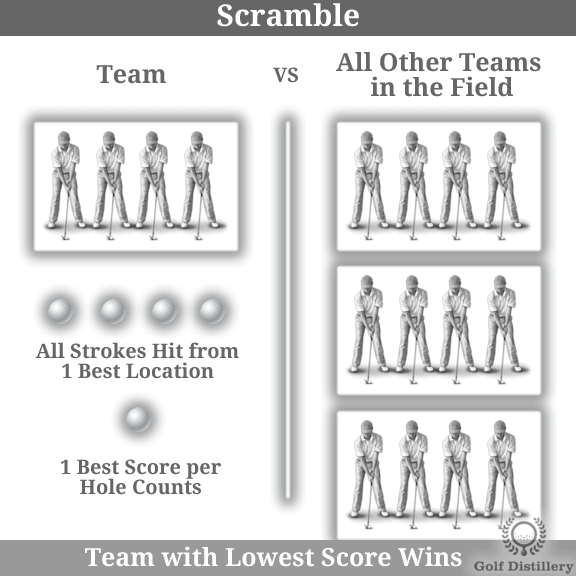
Image Source: www.golfdistillery.com
Deciphering the Basic Golf Scramble Rules
The core concept of the scramble is simple: teamwork makes the dream work. But knowing the specifics is key to a smooth round. While most golf scramble rules are quite standard, always check the local event sheet for any unique twists.
What Happens on Each Shot?
The sequence of play in a standard scramble follows these steps:
- Tee Shot: All four players hit their tee shot.
- Selection: The team chooses the best drive—the one they think gives them the best chance for the next shot.
- Placing the Ball: All other players pick up their balls and move them to the spot of the chosen ball.
- Next Shot: All players hit their second shot from that selected spot.
- Repeat: This process continues until one ball is putted into the hole.
The score recorded for the hole is the total number of strokes taken by the team using the chosen balls.
The “Within a Club Length” Rule
When placing the ball after selecting the best shot, there are specific placement rules for golf scrambles.
- Proximity: The ball must be placed “within one club length” of the original spot.
- Area: The ball must be played from the same surface (e.g., if the best shot was in the rough, the next shot must also be played from the rough).
- No Advantage: Players cannot improve their lie. If the best shot was in a divot, the next shot must also be played from that divot.
Exception: If the selected ball is in a hazard (like a bunker or water) or out of bounds, the team usually gets to move the ball according to the standard relief rules for that situation, or sometimes just to a preferred spot near the original location (check local rules).
Tee Shot Requirements
Many golf tournament scramble format events have rules to ensure everyone contributes off the tee. A common requirement is the “Call for Tee Shots.”
- Minimum Drives: Each player must have at least two of their drives used during the round. The team usually tracks this on a scorecard.
- Fairness: This rule prevents one star player from driving every hole, which is vital for fair competition and making the game fun for weaker players.
How to Choose a Golf Scramble Team
Picking the right players is crucial for success. Your scramble team strategy starts here. A balanced team usually outperforms a team full of only long hitters.
Key Roles on a Scramble Team
A perfect four-person team usually has members covering different skills:
- The Power Hitter (The Bomber): Someone who can drive the ball 270+ yards. Their job is maximizing distance on par 5s and long par 4s.
- The Accurate Iron Player (The Sniper): This player hits the ball very straight, especially from 100–175 yards. They clean up when the bomber finds the trees.
- The Short Game Artist (The Grinder): This person is excellent around the greens—chipping and putting. In scrambles, the short game often decides the winner.
- The Consistent Player (The Anchor): This person might not be the longest or the best chipper, but they rarely make a double bogey. They keep the team honest and are reliable when others struggle.
Team Composition Considerations
When deciding how to choose a golf scramble team, think about chemistry and skill distribution:
| Skill Category | Importance in Scramble | Why? |
|---|---|---|
| Putting | Very High | Most shots end up close; winning often comes down to sinking a tricky putt. |
| Chipping/Pitching | High | Mistakes near the green are easier to recover from if someone can get it close. |
| Approach Shots (Irons) | Medium | This sets up the birdie opportunities. |
| Driving | Medium/High | Good drives offer easier second shots, but a great drive can be negated by a poor second shot. |
A team of four low-handicap players will usually dominate, but for charity events, look for balance and personality.
Developing Your Scramble Team Strategy
Once the team is set, you need a clear plan. Good scramble team strategy minimizes risk and maximizes birdie chances.
Shot Selection Philosophy
The goal in a scramble is not just to pick the longest shot. The goal is to pick the shot that offers the best chance to score well on the next shot.
- Tee Shots: If Player A hits it 290 yards into deep woods, and Player B hits it 250 yards down the middle of the fairway, you always take Player B’s shot. Safety first!
- Approach Shots: If Player C leaves a 10-foot putt for birdie, and Player D hits it 30 feet past the pin, you take Player C’s ball, even if it was slightly farther away but left an easier line.
- Wind and Hazards: Always factor in the weather. If the wind is blowing hard left-to-right, favor the player whose shot stays low or plays into the wind better. If a hole has a water hazard on the right, favor the player who naturally fades the ball away from the hazard.
The Putting Strategy
Putting is where most teams fail in scrambles. Because everyone gets to putt, teams often fall into bad habits.
- The First Putt: The first player up should be someone who can read the green well. They are hitting “for information.” If they make it, great! If they miss, the next player has a perfect read.
- Reading the Line: The team should discuss the break after the first putt falls. If the first player missed left, everyone else should aim slightly more left, even if they thought the break was different.
- The Pressure Putt: The last player putting should be the team’s best putter. They have the advantage of seeing how three other people approached the cup. They are putting for the “win” or the “save.”
Scramble golf tips and tricks often focus on this last putt. Don’t let the best putter hit first if the hole is easy to read. Save them for last to sink the critical shot.
Managing the “Drop Zones”
When playing from a selected spot, sometimes the best shot is in a terrible location—like the front fringe when the hole is in the back.
- If the best ball is on the fringe or fairway, and the team wants to putt: They can usually elect to putt, as long as they stay within the club length rules.
- If the best ball is in deep rough: The team should look for the spot nearby that is on the short grass, but still within that club length of the original spot. You want to give your next striker the best chance to reach the green or get close.
Golf Scramble Handicaps and Scoring Rules
Golf scramble scoring rules are different from standard stroke play. Since the format greatly reduces variance, raw scores are very low. To make it fair across different skill levels, handicapping is essential.
How Golf Scramble Handicaps Work
A scramble handicap adjusts the team’s final gross score to create a net score. This is crucial for a fair golf tournament scramble format.
The most common method involves subtracting a percentage of the team’s combined handicap index.
Standard Handicap Calculation Table (Four Players):
| Player Handicap (HCP) | Total Team HCP | Handicap Multiplier | Team Handicap Allowed |
|---|---|---|---|
| 4, 8, 12, 16 | 40 | 20% – 30% (Varies) | 8 – 12 Strokes |
| 10, 10, 10, 10 | 40 | 20% – 30% (Varies) | 8 – 12 Strokes |
| 20, 20, 20, 20 | 80 | 30% – 40% (Varies) | 24 – 32 Strokes |
Common Handicap Formulas (Check Event Rules!):
- The 25% Rule (Most Common): Add the four individual handicaps together. Then, take 25% of that total sum. This is the team’s handicap allowance.
- Example: Team A has handicaps: 5, 10, 15, 20. Total = 50. Team Handicap = 50 x 0.25 = 12.5. If they shoot 68, their net score is 68 – 12.5 = 55.5.
- The Sliding Scale (For uneven teams): Some organizers use a sliding scale to benefit teams with a wider gap in skill levels.
- Player 1 (Lowest HCP): Use 35% of their handicap.
- Player 2: Use 25% of their handicap.
- Player 3: Use 15% of their handicap.
- Player 4 (Highest HCP): Use 5% of their handicap.
If you are running your own event, keeping the handicap between 20% and 35% of the total sum usually works well. The lower the percentage, the more difficult the tournament will be.
What are the Best Golf Scramble Formats?
While the 4-person, “best ball after all hit” is standard, there are variations to change the game flow. Knowing the best golf scramble formats can keep your events fresh.
Modified Scramble Formats
These formats mix in elements of stroke play to encourage more individual effort:
- 2-Person Scramble: Teams of two play using the same rules. This requires much tighter collaboration.
- The “1-2-3” Scramble: This format forces participation:
- Hole 1, 4, 7, 10, 13, 16: Use only one of each player’s drives.
- Hole 2, 5, 8, 11, 14, 17: Use only two of each player’s drives.
- Hole 3, 6, 9, 12, 15, 18: Use all three of each player’s drives.
- Note: This is often played with 3-person teams but can be adapted.
- The Worst Ball Format (or Shamble): Teams hit tee shots. They select the worst drive to play from. After the second shot, they switch to Best Ball rules. This adds excitement and requires solid second shots.
Scramble Golf Tips and Tricks for Lower Scores
To consistently shoot under par in a scramble, you need more than just good players; you need great execution and strategy.
Pre-Round Preparation
- Know Your Yardages: While you are playing from the same spot, knowing exactly how far Player A hits their 7-iron helps when selecting the next shot into the green.
- Practice Putting Together: Spend 15 minutes before the round practicing short putts together. Agree on speed and line recognition as a unit.
In-Game Execution Tips
- Play Aggressively on Par 5s: Since you have three do-overs, always try to reach par 5s in two strokes. If the first two shots are safe, the third shot can be a very aggressive fairway wood or long iron aimed at the green.
- Never Leave a Putt Short (If Possible): If you are putting for a birdie putt of 15 feet, aim for the ball to end up 1 foot past the hole if it misses. A ball that stops short of the hole often catches the lip or slides by, while a slightly firm putt has a better chance of going in or catching the back of the cup.
- Use the “Carry” Shot: If you have a chance to hit a shot over a hazard or a bunker, choose the player who can fly the ball the farthest, even if their landing area isn’t perfect. In scrambles, carrying the obstacle is often better than playing short and having to hit over it later.
- Avoid the “Too Many Cooks” Syndrome: Once the team captain or designated strategist makes the call on which ball to play, everyone must commit to that line. Second-guessing the chosen shot distracts the next player.
Mastering Course Management
Think about the entire hole, not just the current shot.
- Pin Position Awareness: If the flag is tucked tight behind a bunker, don’t automatically select the longest shot if it puts the ball on the wrong side of the green. Take the shorter, safer shot that leaves a straight 15-foot putt rather than a long, breaking putt from the wrong quadrant.
- Bunker Play: If the best drive leaves you facing a greenside bunker, the priority shifts. Select the player who is best at hitting high-lofted wedges with spin. Do not select the bomber who hits a low, running shot into the sand.
Rules for Golf Scrambles: Common Disputes Settled
While the basic format is straightforward, disputes often arise over placement and relief. Clarifying these points prevents arguments later.
Relief When the Best Ball is Badly Positioned
This is where many casual scrambles differ from professional ones. Always ask the rules committee beforehand.
| Situation | Typical Professional/Strict Rule | Typical Casual/Charity Rule |
|---|---|---|
| Ball in Deep Rough | Must play from the rough within one club length. | Allowed to place the ball on the fairway cut nearest the spot, within one club length. |
| Ball in a Divot | Must play from the divot. | Allowed to press down the grass or place the ball on a preferred lie. |
| Ball in a Hazard (Water) | Standard penalty drop applies. | Often allowed to place the ball near the hazard entrance without penalty. |
Hitting Out of Turn
In a scramble, players must generally hit in order from the selected spot, unless the first player is only hitting for information (like the first putt). However, if someone hits out of turn by mistake:
- If the first player hasn’t hit yet: The stray shot usually counts as the first player’s stroke, provided the team agrees to use it.
- If the group is confused: It is best to replay the shot, ensuring the correct player hits next. Good communication prevents this entirely.
When Everyone Misses the Green
If the first three players miss the green, the fourth player must still hit. If they also miss, the team selects the best shot among the four and proceeds. If the selected shot was, say, 20 feet off the green, the team repeats the process for their second shot from that spot (within one club length of the previous chosen ball).
FAQ Section
Q: Do I use my personal handicap in a scramble?
A: Yes, you typically use your established course handicap to calculate the team handicap allowance, as outlined in the golf scramble handicaps section. The goal is to level the playing field between high and low handicappers.
Q: Can we use a mulligan in a scramble?
A: This depends entirely on the event host. Many charity scrambles sell mulligans as a fundraiser. If mulligans are allowed, the team usually decides which player gets to use it and when.
Q: What is the difference between a scramble and a best ball?
A: A scramble involves everyone hitting until the best shot is chosen, and everyone plays the next shot from that spot. Best ball golf format (or four-ball) means everyone plays their own ball from start to finish, and the team only records the single lowest score from that hole.
Q: How many players are usually on a scramble team?
A: Four players is the traditional number, making it a “four-person scramble.” However, if you have an odd number of players, you can play with threesomes or twosomes, adjusting the team handicap accordingly.
Q: What happens if my team runs out of designated drives?
A: If you are playing a format that requires a minimum number of drives per player (like the 1-2-3 scramble), and you run out, the team usually faces a penalty (often two strokes added to the final score) or must use the player who has already met their quota for the remaining drives. Always confirm this rule before the first tee.